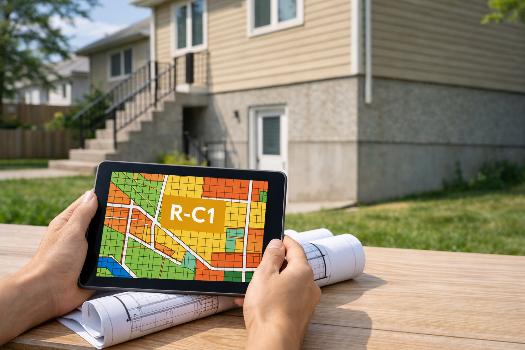
Before anything else, your property needs to sit in a zone that actually permits a secondary suite. Calgary's Land Use Bylaw governs this, and not every neighbourhood is created equal. Most R-C1s (single-detached residential with secondary suite) and R-C2 lots allow it, but you'd be surprised how often homeowners assume they're in the clear only to find out their zoning doesn't support it.
The City's online map tool can help you check, but reading a zoning designation correctly isn't always straightforward. A lot of homeowners miss the distinction between a permitted use and a discretionary use - and those two things lead to very different approval processes. If your zone lists secondary suites as discretionary, you'll need to apply for development approval before you even pull a building permit.
First off, get the zoning sorted before you spend a dollar on construction. It's one of those things that costs nothing to check and a tremendous amount to get wrong.
Here's the thing about city permits - they exist for a reason, and skipping them is the number one mistake we see homeowners make when developing a legal suite.
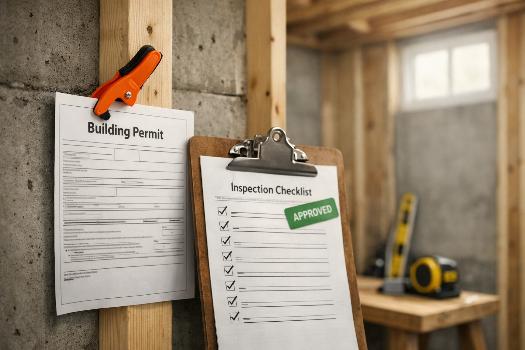
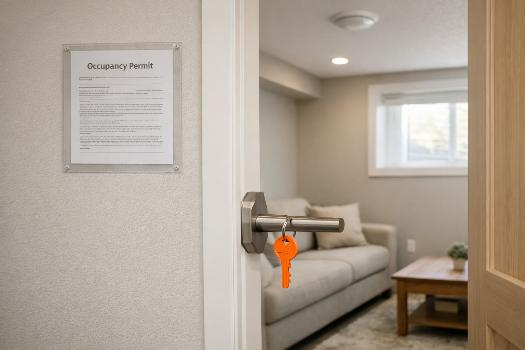
You'll need both a development permit (in most cases) and a building permit. The building permit triggers inspections, which is actually a good thing. Inspections are what give you proof that the work was done correctly. Without them, you have no occupancy permit - and without an occupancy permit, you technically don't have a legal rental suite, full stop.
The permit process can feel slow and bureaucratic, but it's also what protects you down the road. Unpermitted suites have a funny way of surfacing during real estate transactions, insurance claims, or - worst case - after an incident. Calgary's Safety Codes Office doesn't mess around when it comes to habitable spaces.
If there's one area where the building code is completely uncompromising, it's fire separation. A secondary suite needs to be separated from the main dwelling with a fire-resistance-rated assembly - typically one hour. That means the right combination of framing, insulation, and drywall (usually 5/8" Type X drywall on the ceiling and walls between the two units).
It sounds straightforward, but the details trip people up constantly. Every penetration through that assembly - pipes, wires, ducts - needs to be fire-stopped. And the suite needs its own direct means of egress that doesn't run through the main unit. That means a separate entrance, either through an exterior door or a code-compliant path that gets you outside without passing through someone else's living space.
We've walked into basement renovations that looked finished and professional from the outside, but had drywall that wasn't fire-rated, unsealed penetrations, and shared mechanical systems that would never pass inspection. Good intentions don't equal code compliance.
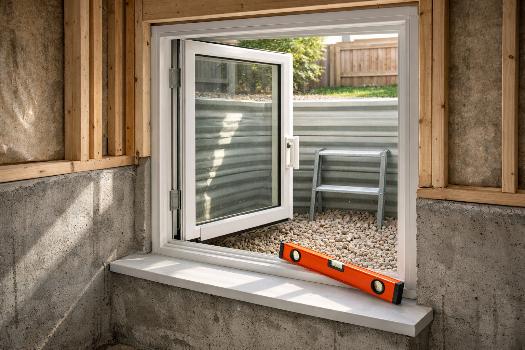
Every sleeping room in a secondary suite needs an egress window - a window large enough that an occupant can actually escape through it in an emergency, and that a firefighter can enter through. The minimum opening is 0.35 square metres, with a minimum width of 380 mm and minimum height of 380 mm. The sill can't be more than 1,000 mm off the finished floor.
A lot of existing basement windows don't meet these minimums. Cut-down, slider-style windows from older construction almost never do. This usually means window well excavation and a new window installation - it's not a big job on its own, but it does add to the overall scope and it absolutely cannot be skipped.
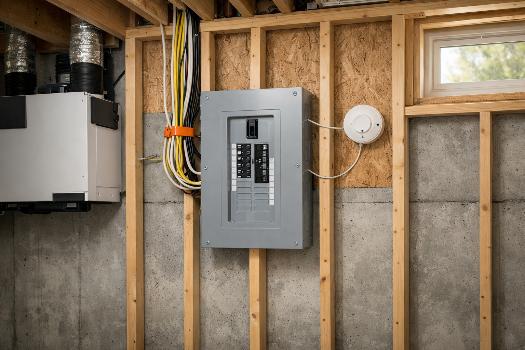
A legal suite needs its own electrical panel or at minimum a sub-panel with dedicated circuits. The suite's smoke and CO detectors need to be interconnected with the main dwelling's detectors - so if one goes off, they all go off. That's a life-safety requirement, not a suggestion.
On the mechanical side, the suite needs its own heat source. You can't just extend ductwork from the main home's furnace and call it done - the suite needs to be independently heatable, and in many cases you'll need a separate HRV or ventilation setup. Bathroom fans need to vent to the exterior, not just into the ceiling cavity (yes, we've seen that more than once).
Plus, if the suite shares utilities with the main house - gas, water, electricity - the City will want to see how those are metered or separated. Utility independence isn't always required, but it's strongly encouraged and often expected.
After all the inspections are passed - framing, electrical rough-in, plumbing rough-in, insulation, and final - you can apply for an occupancy permit. This is the document that officially says the suite is safe to live in. It's what makes it legal.
Without it, you're renting out a space that exists in a legal grey area at best. Some landlords do it anyway and get away with it for years. But one complaint to 311, one insurance claim after a fire, or one tenant who knows their rights, and the whole thing unravels very quickly. The occupancy permit is not a formality - it's the whole point.
We've seen homeowners take a run at basement legal suite development as a DIY project. Sometimes they get partway through before realizing the permit requirements are more involved than expected. Sometimes they complete the work and fail inspections. Sometimes they sell the home and the unpermitted suite becomes a deal-killer or a price-reduction negotiation.
The cost of doing it right the first time is almost always less than the cost of fixing it later. Retroactive permits, remediation work, and delays on a sale or rental income add up fast.
At Alberta Elite Construction, we handle the whole process - from zoning checks and permit applications through to final inspections and the occupancy permit. We've been through this process enough times to know where the complications tend to show up, and we handle them before they become your problem.
If you're thinking about legal secondary suite construction in Calgary, we'd love to talk it through with you. No pressure, no jargon - just a straight conversation about what your home needs and what it'll take to get there. Visit our legal suite development service page to learn more about what we do, or get in touch directly. We're happy to help.