
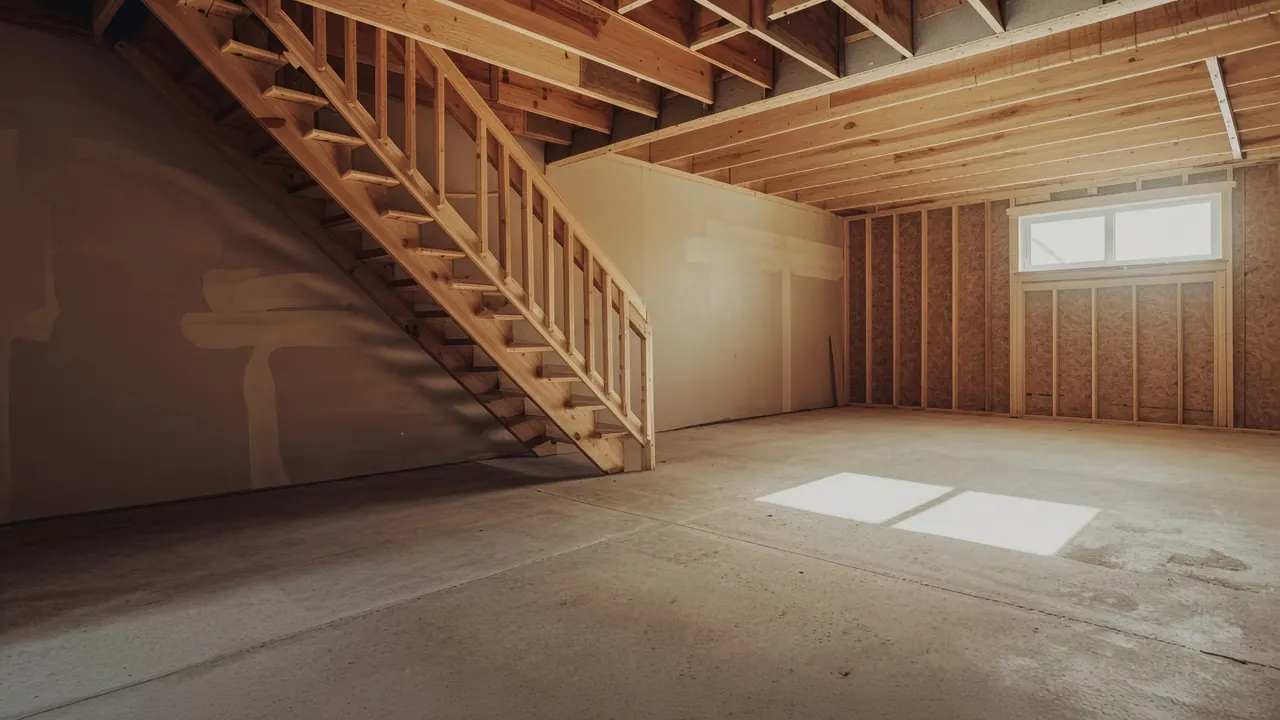
Basement Development
The Ultimate Guide to Basement Development in Calgary: Permits and Planning
March 16, 2026
Get a quote →There's a running joke among Calgary homeowners that goes something like this: the most expensive room in your house is the one you're not using. And for a lot of people in established neighbourhoods like Brentwood, Rundle, or Woodbine, that room is the entire lower level - a cold, dusty basement that's been storing hockey gear and forgotten furniture since the house was built.
Here's the thing: that space has real potential. A finished basement in Calgary can add anywhere from 15 to 30 percent to your home's resale value, and more importantly, it gives your family the room it actually needs - whether that's a rec room, a proper home office, an extra bedroom or two, or even a legal secondary suite that helps offset your mortgage. The bones are already there. You've already paid for the square footage. All that's left is developing it properly.
But "properly" is the operative word.
This guide to basement development in Calgary is written specifically for homeowners who already own a house. You're not breaking ground on a new build - you're working with what you've already got, and that changes everything about how the process works, what the city expects from you, and what surprises might be lurking behind that old drywall.
Understanding the 'Why' Behind Calgary's Strict Basement Rules
Before you start browsing Pinterest for flooring ideas, it helps to understand why the City of Calgary takes basement renovations so seriously. It's not bureaucracy for its own sake - there are real, consequential reasons.
Older Calgary homes - especially those built between the 1950s and the 1990s - were often constructed to the building codes of their era, not today's standards. Fire egress, electrical capacity, structural loading, insulation, and moisture management have all evolved dramatically. When you develop an unfinished basement, you're not just decorating a room - you're creating habitable living space inside an existing structure, and the city wants to make sure it's safe for the people who'll live in it.
Secondary suites add another layer of complexity. If your goal is to create a legal basement suite in Calgary, you're essentially adding a dwelling unit to your existing home. That triggers requirements around fire separation, sound insulation, separate entrances, and compliance with the city's land use bylaw for your specific neighbourhood. Get it wrong and you're either running an illegal suite or you're looking at tearing out completed work to bring it up to code.
Understanding the 'Why' Behind Calgary's Strict Basement Rules
Navigating the Calgary Permit Maze for Your Existing Home
Do I Really Need a Permit? (Spoiler: Probably Yes)
This is the question we get constantly, and the answer almost always comes back the same way: if you're doing anything beyond cosmetic updates, yes - you need a permit.
Cosmetic work (painting, replacing flooring, swapping out light fixtures like-for-like) can generally proceed without pulling a permit. But the moment you're framing new rooms, adding or moving electrical circuits, touching plumbing, installing a bathroom, creating egress windows, or adding anything that changes the structure or function of the space, you are firmly in permit territory.
Honestly, this is where a lot of people slip up. They figure they can frame a bedroom and finish the walls without telling anyone, and sometimes it works out - until they try to sell the house. An unpermitted renovation is a material disclosure issue in Alberta, and buyers' home inspectors are trained to spot it. You can end up in a situation where you either disclose and renegotiate the price, or worse, undo work that was never inspected.
The Development Permit vs. Building Permit Confusion
These two terms sound interchangeable, but they're quite different, and mixing them up costs people serious time.
A building permit is what most basement renovations require. It covers the actual construction work - structural changes, electrical, mechanical, and plumbing. You apply for it through the City of Calgary's MyPermit portal, and it's reviewed against the Alberta Building Code and applicable city bylaws.
A development permit is a separate, land use document. For most basement renovations in an existing home - say, finishing a rec room or adding bedrooms - you won't need a development permit. But if you're creating a secondary suite in your existing home, a development permit is almost always required. This is because you're changing the official use of the property, and the city needs to confirm that secondary suites are permitted within your home's land use district. Some older neighbourhoods in Calgary have restrictions, and some have been rezoned specifically to encourage secondary suites. It varies considerably by area, so this is one of those things worth checking early.
Do I Really Need a Permit? (Spoiler: Probably Yes)
The Development Permit vs. Building Permit Confusion
What You'll Need for Your Application
The permit application for a basement renovation in an existing Calgary home typically requires architectural drawings showing your proposed layout - room dimensions, ceiling heights, door and window locations, egress compliance, and how you're handling the mechanical systems. For a secondary suite, you'll also need to demonstrate fire separation between the suite and the main dwelling.
You don't need stamped engineering drawings for most standard renovations, but if you're making structural modifications - removing posts, altering beam configurations, or cutting new window openings in your foundation - you'll likely need to involve a structural engineer.
The tip we always give homeowners here: this is precisely where having a professional contractor saves you weeks of back-and-forth with City Hall. An older home often doesn't match what's on file with the city - previous owners may have made changes without permits, rooms may have been informally modified, and the existing mechanical layout may not align with any drawing that exists. A contractor experienced with older Calgary homes knows how to navigate those discrepancies on the application and avoid rejection delays.
What You'll Need for Your Application
Planning Your Layout Around What's Already There
Egress Windows (Retrofitting into Existing Foundations)
If you're adding any bedrooms - or even a den that functions like a bedroom - you need egress windows. The Alberta Building Code requires that sleeping rooms in basements have at least one window that meets minimum size requirements for emergency escape. The clear opening must be no less than 0.35 square metres, with no dimension less than 380 mm.
Now, here's the kicker: in an already-built home, those windows don't exist yet. Installing egress windows means cutting openings into your existing concrete or block foundation - a task that requires a concrete saw, temporary shoring of the foundation, waterproofing at the new opening, and proper window well installation outside. It's not a weekend project. When done well, it's genuinely transformative - bringing natural light into what was a cave-like space. When done poorly, you've created a water entry point right at the base of your house.
The 'Warm Zone': Insulation and Vapor Barriers in an Existing Space
A lot of Calgary basements - particularly in homes built before the late 1980s - have bare concrete walls with no insulation at all. Finishing that space without addressing this properly is a recipe for condensation, mould, and energy bills that make your eyes water.
Calgary's climate is brutal on below-grade assemblies. We're talking freeze-thaw cycles that affect the ground right up against your foundation walls, and interior conditions that shift dramatically between seasons. The current Alberta Building Code requirements call for a minimum of R-10 continuous insulation on basement walls, though R-14 to R-20 is more practical in Calgary's climate zone.
The approach matters as much as the R-value. Spray foam applied directly to the concrete is generally considered the best option for existing foundations because it acts as both insulation and a vapour barrier in a single application, and it accommodates the minor irregularities you always find on an old concrete wall. Batt insulation in a stud wall works too, but it needs a proper vapour barrier on the warm side, and the stud wall needs to be set far enough from the concrete that moisture can't accumulate behind it.
Egress Windows (Retrofitting into Existing Foundations)
The 'Warm Zone': Insulation and Vapor Barriers in an Existing Space
Headroom and Mechanicals - The 'Oh No' Moment
You might be wondering why we always recommend measuring your existing headroom before you even start sketching a layout. Here's why: the Alberta Building Code requires a minimum ceiling height of 1.95 metres (roughly 6'5") in all habitable rooms in a developed basement. The catch is that furnace ducts, plumbing stacks, beams, and electrical panels were installed with storage rooms in mind, not finished living space.
That ductwork that's been humming along since 1978 at 6'2" off the floor is now your design problem. Sometimes you can reroute; sometimes you can wrap it in a soffit and work with it aesthetically. But occasionally you pull back the drop ceiling tiles you put up "just to see" and discover that the entire main trunk line runs right through the middle of your living room plan.
This is the part of basement renovation in established Calgary homes that requires real experience. Knowing when a duct can be moved, what that costs, and how to adjust a floor plan accordingly - that's the difference between a finished basement that flows well and one that has a random bulkhead eating into every room.
Headroom and Mechanicals - The 'Oh No' Moment
The Hidden Essentials When Working with an Existing Foundation
Radon Gas Mitigation - Adding It to an Older Home
If you're finishing a basement in Calgary, radon mitigation is not optional - it's essential. Health Canada data consistently shows that Calgary sits in a part of Alberta with elevated radon risk, and many older homes have never been tested or equipped with mitigation systems.
Radon is a naturally occurring radioactive gas that seeps up through the soil and into homes through cracks in foundations and slabs. In an unfinished basement, there's some natural dilution because the space is often drafty. Once you seal and finish that space - adding drywall, proper insulation, and airtight windows - you can actually concentrate radon if you haven't addressed it.
The standard approach is a sub-slab depressurization system: a pipe is inserted through the existing slab, connected to a fan mounted outside or in an accessible attic space, which continuously draws radon-laden air from under your slab and vents it away from the house. Retrofitting this system during a basement renovation is far more cost-effective than adding it after the fact, because you already have access to the slab before you put down your flooring.
Weeping Tiles and Sump Pumps - Assessing What's There
Before finishing a single wall, you need to understand how your existing foundation handles water. Calgary's spring thaw and occasional intense summer rain events put serious pressure on residential drainage systems, and the weeping tile systems in older homes can fail silently over decades.
If your house was built before roughly 1980, your weeping tile is likely clay or tar-coated fibre pipe - neither of which has an indefinite lifespan. A wet spring in an unfinished basement is a nuisance. A wet spring after you've put $40,000 into drywall, flooring, and trim is a disaster.
We always recommend a drainage assessment before starting a basement renovation in an older Calgary home. If the sump pit is undersized, the pump is original to the house, or there are signs of past water intrusion (efflorescence on the walls, cracks at the base of the foundation), those things need to be sorted out before framing begins. It's far cheaper to address drainage proactively than to remediate water damage after the fact.
Radon Gas Mitigation - Adding It to an Older Home
Weeping Tiles and Sump Pumps - Assessing What's There
The Inspection Game: What the City Looks For in a Renovation
The City of Calgary's inspection process for a basement renovation typically involves at least two mandatory inspections: a framing inspection (which also covers rough-in electrical, plumbing, and mechanical before the walls are closed up) and a final inspection once the work is complete.
The framing inspection is where unpermitted surprises come home to roost. If an inspector finds that your egress window isn't compliant, your smoke and CO detectors aren't placed correctly, your fire blocking isn't done properly, or your electrical rough-in has issues - all of that needs to be corrected before you're allowed to close the walls. Every correction costs time, and in some cases, if work was done in the wrong sequence, it means opening up work that's already been completed.
Let's be real for a second: failing an inspection is not the end of the world, but it is expensive and demoralizing, especially if you've already been living in construction mode for weeks. The way we see it, passing on the first go isn't luck - it's preparation. When you work with a contractor who's completed hundreds of basement renovations in Calgary's established housing stock, they know exactly what the inspector will look for in a space that has existing conditions that new builds simply don't have. That institutional knowledge is genuinely valuable.
The Inspection Game: What the City Looks For in a Renovation
The City of Calgary's inspection process for a basement renovation typically involves at least two mandatory inspections: a framing inspection (which also covers rough-in electrical, plumbing, and mechanical before the walls are closed up) and a final inspection once the work is complete.
The framing inspection is where unpermitted surprises come home to roost. If an inspector finds that your egress window isn't compliant, your smoke and CO detectors aren't placed correctly, your fire blocking isn't done properly, or your electrical rough-in has issues - all of that needs to be corrected before you're allowed to close the walls. Every correction costs time, and in some cases, if work was done in the wrong sequence, it means opening up work that's already been completed.
Let's be real for a second: failing an inspection is not the end of the world, but it is expensive and demoralizing, especially if you've already been living in construction mode for weeks. The way we see it, passing on the first go isn't luck - it's preparation. When you work with a contractor who's completed hundreds of basement renovations in Calgary's established housing stock, they know exactly what the inspector will look for in a space that has existing conditions that new builds simply don't have. That institutional knowledge is genuinely valuable.
The Bottom Line: Is DIY Permit Navigation a False Economy?
This guide to basement development in Calgary only scratches the surface of what goes into a well-executed renovation - every house is different, and your existing basement comes with its own set of opportunities and challenges. If you're serious about developing your basement the right way, with the permits, inspections, and professional expertise that protect your investment,visit our Basement Development service pageorcontact the Alberta Elite Contractors teamto get started.
The Bottom Line: Is DIY Permit Navigation a False Economy?

Get in touch
Request a free consultation
Contact Alberta Elite Construction today for a clear written quote and dependable workmanship.
Contact us now Call (587) 332-2255