
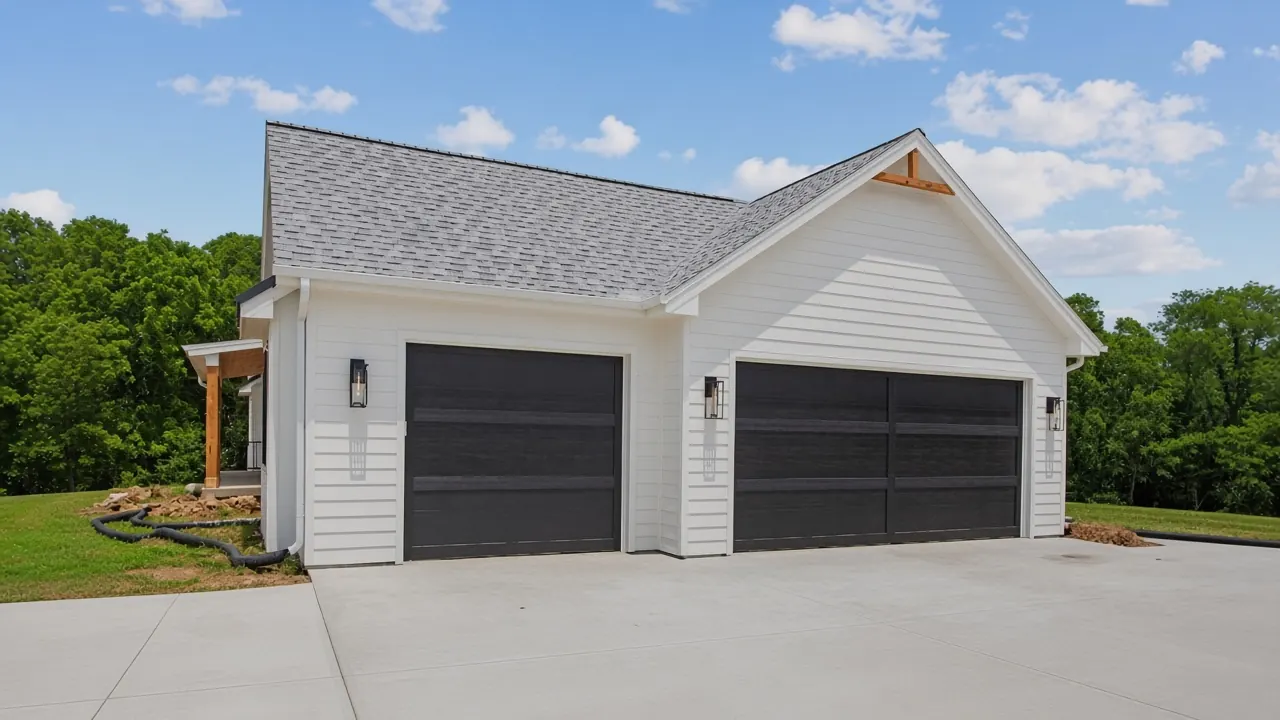
Garage Development
How to Build a Heated Garage: A Complete Guide for Calgary Homeowners
April 11, 2026
Get a quote →If you've spent a Calgary winter trying to warm up a car in a garage that feels like the inside of a freezer, you already know the problem. What most people don't realize, though, is that a cold garage isn't just an inconvenience - it's often a sign that the structure was never properly built for our climate in the first place.
Calgary winters are no joke. We regularly see temperatures drop to -30°C, and that's before the wind chill. Add in those wild Chinook swings where the temperature can jump 20 degrees in a matter of hours, and you've got a structure that gets thermally stressed in a way that most building guides written for milder climates never bother to account for.
At Alberta Elite Construction, we've built and developed garages all across the city. And over the years, one thing has become crystal clear: the difference between a garage that stays reasonably warm and one that stays cold no matter how much heat you throw at it almost always comes down to what happened during construction. Insulation, vapour barriers, the slab - all of it matters, and all of it needs to be done in the right order and the right way.
This guide covers everything you need to know if you're looking to figure out how to build a heated garage in Calgary, from foundation to roofline, and from insulation choices to heating systems. Whether you're planning a new build or retrofitting an existing structure, there's plenty here to work with.
Why Calgary's Climate Demands a Different Approach
A lot of homeowners look at garage insulation guides from Ontario or the Pacific coast and assume the recommendations will translate. They don't - at least not fully.
Calgary sits in a climate zone where we deal with extreme cold, low humidity in winter, and significant temperature variability. The ground freezes deep, which affects how you handle your slab and foundation. The dry air means moisture management works a bit differently than in humid climates. And the Chinooks - those warm westerly winds that roll in off the Rockies - create rapid temperature cycling that puts real mechanical stress on materials and joints over time.
The first thing to keep in mind is that any heated garage in Calgary needs to be treated as a proper thermal envelope. That means air-sealing matters just as much as insulation values. A garage with R-20 walls but gaps around the door frames and ceiling penetrations will still haemorrhage heat all winter long.
Starting From the Ground Up: Slab and Foundation Insulation
Most Calgary garages are built on a concrete slab over compacted gravel. It's a perfectly functional approach, but the slab itself can be a significant source of heat loss if it's not addressed properly.
Concrete is a decent conductor of cold. In a heated garage, your slab is sitting on ground that might be at 2°C or 3°C (or colder during deep cold snaps), and without any insulation between that ground and your finished floor, you're fighting a losing battle. Slab insulation for garages typically involves placing rigid foam - usually extruded polystyrene (XPS) or expanded polystyrene (EPS) - either underneath the slab during the pour or on top of it when finishing the floor later.
Under-slab insulation is the gold standard. A 2-inch layer of XPS (which carries an R-value of roughly R-10) placed beneath the slab before the concrete is poured makes a noticeable difference in how warm a heated slab or even just a heated space feels underfoot. If you're building new, this is absolutely worth doing. The cost of adding it at pour time is minimal compared to the benefit.
If you're retrofitting an existing slab that doesn't have insulation, the options are a bit more involved. Some homeowners install sleepers over the existing concrete, add rigid foam between them, and then put a wood subfloor on top. This raises the floor height by a few inches, which can create issues with garage door clearance and entry thresholds - something to plan for carefully.
Another thing people often overlook is the frost wall or stem wall at the perimeter of the slab. In Calgary, garages need to be set on foundations that go below the frost line (typically around 4 feet), and insulating the exterior or interior face of that foundation wall helps prevent cold from conducting inward along the concrete. Adding 2 inches of rigid foam on the interior face of the foundation wall, running from grade level down to the footing, is a practical and cost-effective upgrade.
Wall Insulation: Getting the R-Value Right
For garage walls in Calgary, you're generally working with wood-frame construction - 2x4 or 2x6 studs on treated bottom plates - and the right insulation approach depends on what you have to work with and what you're trying to achieve.
Batt Insulation in 2x4 and 2x6 Walls
The most common approach is fiberglass or mineral wool batt insulation installed between the studs. In a 2x4 wall, you're looking at roughly R-12 to R-14 with a good-quality batt. In a 2x6 wall, you can hit R-20 or even R-22 with a dense-pack product.
For a heated garage in Calgary, R-20 in the walls is a reasonable minimum target. It's actually worth bumping up to R-24 if you're building 2x6 and planning to heat the space year-round, especially if you're using it as a workshop. The incremental cost difference is small, and the payoff in comfort and reduced heating bills is real.
Mineral wool batts are worth considering over standard fiberglass. They hold their R-value more reliably when compressed or fitted around obstacles, they're water-resistant, and they add some acoustic benefit as well. The cost is higher, but for a garage that's going to see daily use, it tends to be worth it.
Adding Continuous Rigid Foam
Here's where it gets interesting - one of the more effective upgrades you can make to garage walls is adding a layer of continuous rigid foam on the interior face of the stud wall before you close up with drywall or OSB. Even a 1-inch layer of polyisocyanurate foam board (roughly R-6) dramatically reduces thermal bridging through the studs themselves. Studs conduct cold, and in a 2x6 wall, the studs can account for 15-20% of the total wall area. Continuous insulation breaks that bridge.
This approach adds a few inches of thickness to the interior wall and requires you to accommodate electrical boxes and other penetrations carefully, but for a garage where you're really trying to maximize thermal performance, it's a legitimate upgrade.
Batt Insulation in 2x4 and 2x6 Walls
Adding Continuous Rigid Foam
Vapour Barriers: Getting This Right Matters
Vapour barriers are one of those topics where a lot of DIYers get into trouble. In a heated garage in Calgary, you absolutely need a vapour barrier - but it needs to be installed on the warm side of the insulation (the interior face, facing into the heated space), and it needs to be detailed carefully.
The standard product is 6-mil polyethylene sheeting. You staple it to the warm face of the studs before installing your wall finish, overlapping seams by at least 6 inches and taping all joints with acoustical sealant or polyethylene tape. Any penetrations - for electrical boxes, pipes, HVAC runs - need to be sealed around the perimeter with acoustical sealant.
Why does this matter so much? Because Calgary winters are dry, and your heated garage is going to have a much higher vapour pressure on the inside than outside. Without a proper vapour barrier, warm moist air moves through the wall assembly and hits the cold sheathing, where it condenses. Over time, that moisture causes wood rot and mould inside the wall cavity - damage that can be invisible until it's already serious.
A couple of common mistakes to avoid:
- Don't use the vapour barrier as a substitute for air sealing. They're related but not the same. The barrier controls moisture diffusion; air sealing (with caulk and foam at all penetrations and framing intersections) stops air movement.
- Don't put poly on both sides of the wall. The exterior side should use a breathable building wrap that lets any moisture that does get in escape to the outside.
Ceiling Insulation: Don't Underestimate This One
Heat rises. Which means that if your garage has an uninsulated or under-insulated ceiling, you're losing a significant amount of your heating investment straight up through the roof.
For a garage with living space above it or a habitable room over the garage, the ceiling assembly needs to meet residential insulation standards - typically R-40 minimum in Calgary for attic assemblies. For a simple detached garage with an unconditioned attic space above, you have some flexibility, but R-28 to R-40 in the ceiling is a reasonable range to target.
The most common approach is blown-in cellulose or fiberglass in the attic space above the garage ceiling. It's cost-effective, fills irregular spaces well, and settles minimally when installed properly. If the ceiling is accessible from above before it's closed in, batt insulation works too - but making sure it's installed without voids or compression is critical.
For garages with a flat or low-slope roof - something you see in some modern builds - the insulation strategy gets more complicated. You're often dealing with a warm roof or compact roof assembly, where foam board insulation is placed above the structural deck. In these cases, the design needs to be engineered to manage condensation risk properly.
Another thing people often overlook with heated garages is the garage door opening itself - the rough opening framing above the door. This area often gets missed in the insulation envelope, creating a cold bridge right where you really don't want one. Foam board cut to fit between the framing members above the door, combined with proper air sealing, addresses this well.
Choosing an Insulated Garage Door
The garage door is often the largest single opening in a garage, and it can easily be the biggest thermal weak point in an otherwise well-insulated structure. An uninsulated steel door has an R-value of roughly R-2 to R-4. An insulated door with polyurethane foam cores can reach R-12 to R-18 or higher.
For Calgary, a door with a polyurethane foam core (not just polystyrene, which is less thermally efficient and more prone to cracking in the cold) and a thermal break in the steel sections is worth the upgrade. The difference in surface temperature on the interior face of the door on a cold day is substantial.
Weather stripping around the perimeter of the door is equally important. The bottom seal especially wears out over time and should be inspected annually. Cold air infiltration around a garage door that doesn't seal properly can offset a lot of the insulation work you've done elsewhere.
Also worth considering: the door's glazing, if any. Decorative windows in garage doors look great, but they're a thermal liability. If you want natural light in the garage, high-quality double or triple-pane glazing with a good spacer system minimizes the heat loss, but some amount of compromise is unavoidable.
Heating Options for a Calgary Garage
Once you've got the thermal envelope sorted, the next question is how you're going to heat the space. There's no single right answer - it depends on your budget, your gas or electrical service, how you use the garage, and how quickly you need heat when you walk in.
Unit Heaters (Natural Gas or Propane)
Forced-air unit heaters are probably the most common way to heat a detached garage in Calgary. They mount to the ceiling or wall, connect to a gas line, and move a lot of heated air quickly. They're relatively inexpensive to purchase and install compared to other options, and they heat a cold garage fast - which matters when you pull in after a commute and want to work on something.
The downside is that they require proper gas supply and venting, they can stir up dust and debris, and they're not ideal for garages where you're doing finish work like painting or woodworking (the moving air creates problems). They also need regular servicing and the heat exchanger should be inspected periodically for cracks.
For a 600-900 square foot heated garage in Calgary, a 30,000-45,000 BTU unit is typically in the right range, depending on how well the structure is insulated.
Unit Heaters (Natural Gas or Propane)
Electric Unit Heaters
Electric heaters are simpler to install (no gas line needed, no venting) and perfectly adequate for occasional use or smaller spaces. Running costs are higher than gas given Alberta's electricity rates, so they make more sense as a supplemental heat source or in garages with very good insulation where the heat demand is modest.
Infrared electric heaters are an interesting option in this category. They heat surfaces and objects rather than air, which means less heat loss when the door is opened and a more comfortable radiant warmth. They're worth considering for workshop garages where you're stationary and want localized comfort.
In-Floor Radiant Heating
In-floor radiant heat is the gold standard for garage heating, full stop. Hydronic tubing embedded in a heated slab delivers gentle, even heat across the entire floor surface. The floor itself becomes a radiator. There's no forced air, no noise, no temperature stratification, and no cold spots. On a -25°C January morning, walking into a garage with a warm floor feels genuinely luxurious.
The trade-off is cost and complexity. Radiant floor heating needs to be designed into the slab from the start (though there are overlay systems that can be added later). It requires a boiler or water heater to supply hot water to the tubing loops, along with controls and manifolds. The heated garage cost in Calgary for a radiant floor system is significantly higher than a simple unit heater setup - typically $8,000 to $15,000 or more depending on the size of the garage and the boiler chosen.
That said, for a serious workshop, a luxury garage, or a heated garage that's going to double as a living space, the comfort factor and the relatively low operating cost (radiant systems are very efficient once the slab is warmed up) make it worth serious consideration.
Electric Unit Heaters
In-Floor Radiant Heating
Mini-Split Heat Pumps
Mini-split systems are gaining ground as a garage heating solution, and for good reason. They provide both heating and cooling, operate quietly, and have gotten substantially more efficient in cold weather over the last generation of products.
Modern cold-climate heat pumps (look for units rated to -25°C or lower) can maintain good efficiency even in Calgary's coldest weather, though they do work harder and consume more power at extreme temperatures. For a garage that's also used as a workshop or hobby space where you want year-round comfort control, a mini-split is a genuinely compelling option.
The upfront cost is moderate - typically $3,000 to $6,000 installed for a single-zone unit - and operating costs are competitive with gas at current Alberta rates. They do require electrical supply and a refrigerant line set, so professional installation is standard.
Mini-Split Heat Pumps
A Few Words on Permits and Code Compliance
Heated garages in Calgary fall under the National Building Code as adopted in Alberta, plus local Calgary amendments. Any work involving gas lines, structural changes, electrical panel upgrades, or new HVAC systems will require permits, and inspections will follow.
This is genuinely important. Unpermitted work on a heated garage can create problems when you sell the property, may void your home insurance, and in some cases creates real safety risks - particularly around gas appliances and carbon monoxide.
At Alberta Elite Construction, all of our garage development projects are completed with the proper permits and inspections. It's not just a box-ticking exercise - it's how you protect the investment you're making.
The DIY vs. Professional Question
There's plenty of prep work a motivated homeowner can do - basic framing, running batt insulation, even some of the drywall work. But a lot of what makes a heated garage actually perform well in Calgary's climate is in the details: the continuity of the vapour barrier, the integration of the insulation at all the thermal bridges, the sizing and venting of the heating system, and the air sealing at every transition.
These are areas where experience matters. A missed vapour barrier lap that lets condensation form inside a wall cavity won't show up as a problem for a few years - but when it does, it's expensive. An undersized heating system that short-cycles all winter drives up operating costs and wear. Improper gas venting is a safety issue.
Our garage development services at Alberta Elite Construction cover the full scope, from design and permits through insulation, HVAC, and finishing. If you're planning a new heated garage or retrofitting an existing one, we're happy to walk through the options with you.
Frequently Asked Questions
What is the minimum R-value for garage walls in Calgary?
The Alberta Building Code and Calgary's climate zone point toward R-20 as a reasonable minimum for heated garage walls. If you're building 2x6, targeting R-24 is practical and worthwhile. For garages used as living or workshop space year-round, erring on the higher end pays off in comfort and energy costs over time.
Does a heated garage need a vapour barrier in Alberta?
Yes, absolutely. In Calgary's cold dry winters, a 6-mil poly vapour barrier on the warm side of the insulation (interior face of the stud wall) is essential. Without it, moisture from the heated interior migrates into the wall cavity and condenses on the cold sheathing, leading to rot and mould.
How much does it cost to build a heated garage in Calgary?
The heated garage cost in Calgary varies widely based on size, insulation spec, and heating system choice. A basic 24x24 detached garage with insulation, a gas unit heater, and standard finishes typically runs $60,000 to $100,000 or more for a full build including permits. Adding in-floor radiant heat, upgraded insulation, or premium finishes pushes that higher.
Is in-floor radiant heating worth it in a garage?
For garages that see regular use and where comfort is a priority - workshops, hobby spaces, or heated parking for classic cars - radiant floor heat is genuinely worth the investment. It provides even, comfortable warmth with no forced air, and once the slab is at operating temperature the running costs are reasonable. It needs to be designed in from the start.
Can I use a mini-split heat pump in a Calgary garage?
Yes, and modern cold-climate mini-splits are well-suited to Calgary conditions. Look for units with a heating rating down to -25°C or lower. They provide both heating and cooling, operate quietly, and the operating cost is competitive. They're an especially good fit for garage workshops or spaces used year-round.
Does the concrete slab need insulation in a heated garage?
Yes, under-slab rigid foam insulation makes a meaningful difference in a Calgary heated garage. A 2-inch layer of XPS under the slab (installed before the pour) provides approximately R-10 and significantly reduces heat loss to the ground. If you're building new, it's a relatively low-cost upgrade at pour time compared to the benefit.
What kind of garage door is best for a heated garage in Calgary?
Look for a polyurethane foam-core insulated door (not just polystyrene) with a thermal break in the steel sections. R-12 to R-18 is a reasonable range for Calgary winters. Good perimeter weather stripping - especially the bottom seal - is just as important as the door's insulation rating. Inspect the seals annually.
Do I need a permit to build a heated garage in Calgary?
Yes. Any detached garage development in Calgary requires a building permit, and if the project involves gas connections, new electrical service, or HVAC equipment, those components have their own permit requirements. Working with a licensed contractor ensures the permits are pulled, inspections happen, and the finished structure meets code.
How long does it take to heat a cold garage with a gas unit heater?
A properly sized gas unit heater in a well-insulated garage can bring the temperature from -20°C to above freezing in 20-30 minutes. In a poorly insulated garage, it might never get truly warm no matter how long you run it. This is why the insulation work comes first - the heating system is only as effective as the envelope it's working within.
Whether you're starting from scratch or trying to bring an existing structure up to a proper standard, getting garage insulation in Calgary right is the foundation everything else builds on. Take your time with the planning stage, don't cut corners on the vapour barrier and air sealing details, and choose a heating system that matches how you actually use the space.
If you're ready to start planning a garage development, our team at Alberta Elite Construction is here to help.We work with Calgary homeowners on garage buildsfrom initial design through to the finishing details - and we know what it takes to make a structure perform well through a real Alberta winter. Reach out to us and let's talk through what you're working with.

Get in touch
Request a free consultation
Contact Alberta Elite Construction today for a clear written quote and dependable workmanship.
Contact us now Call (587) 332-2255